manuscript
Papyrus 46: 2 Corinthians 11:33-12:9 (c. 175-225)
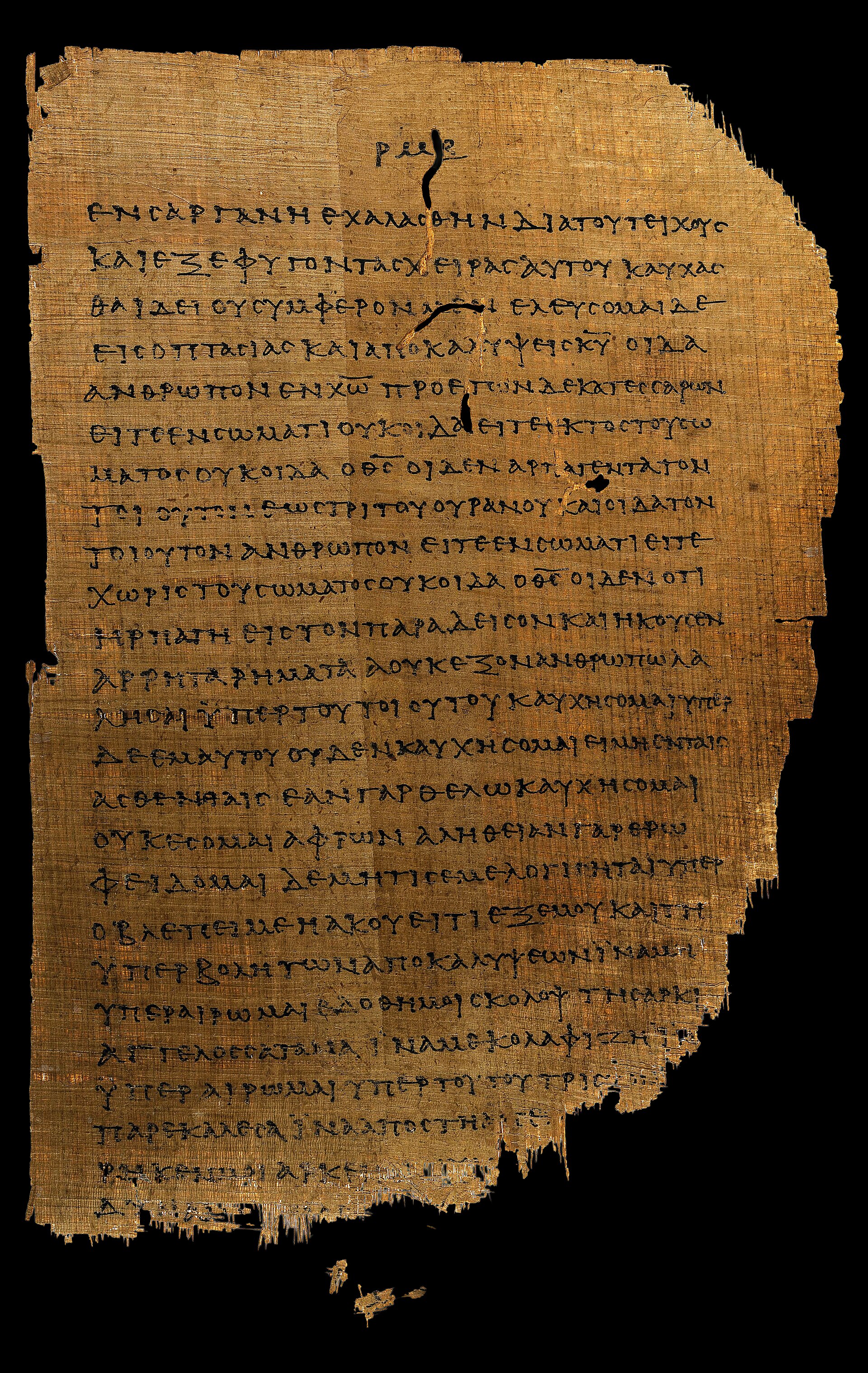
This leaf belongs to Papyrus 46 (P46), also known as Chester Beatty Biblical Papyrus II, the oldest surviving codex of the Pauline epistles. The page shown here — folio 142 recto, in the University of Michigan Papyrus Collection (P.Mich.inv. 6238) — carries part of Second Corinthians, from 11:33 to 12:9. (Scholarship)
What it is
P46 is a codex written on papyrus, gathering a collection of letters attributed to the Apostle Paul. Scholars date it variously; a range of roughly 175-225 CE — the late second to early third century — is commonly cited, which makes it far older than the great parchment Bibles such as Codex Sinaiticus. (Scholarship) Its leaves are today divided between the Chester Beatty Library in Dublin and the University of Michigan, whose portion is reproduced here.
The text on this page
The passage is a vivid stretch of Paul's own first-person testimony. It includes his memory of a narrow escape from Damascus: "And through a window in a basket was I let down by the wall: and so escaped his hands" (2 Corinthians 11:33, Douay-Rheims). (Scripture) It continues into his account of being "caught up to the third heaven" and of the "thorn... in my flesh" (2 Corinthians 12:2-7), and reaches the words that answer his plea: "My grace is sufficient for thee; for power is made perfect in infirmity" (2 Corinthians 12:9). (Scripture) Because 2 Corinthians is among the seven letters near-universally accepted as authentically Paul's, this is text from his own hand as transmitted, on one of the earliest surviving witnesses.
Relevance to Paul
P46 brings us about as close as any object can to the letters as Paul's earliest readers held them. The basket escape it records is tied to Paul's time in Damascus after his conversion, part of the story told in the Acts of the Apostles and in Paul's own letters. For the life behind the text, born in Tarsus, see the reference on the Apostle Paul.
That legacy is what St Paul Global Week marks. On 28-30 June 2027, around the 29 June Solemnity of Saints Peter and Paul, a faith-tourism gathering organised by Funny Tourism will bring pilgrims to Tarsus and Mersin. See the programme.
Provenance
Folio 142 recto of Papyrus 46 (also called Chester Beatty Biblical Papyrus II), the University of Michigan leaves catalogued as P.Mich.inv. 6238. The papyrus is public domain by age and the reproduction carries the Public Domain Mark 1.0 on Wikimedia Commons. Scholarly datings of the manuscript vary; a range of roughly the late second to early third century is commonly cited.
Credit and source
- Source:
- University of Michigan Papyrus Collection (P.Mich.inv. 6238) (via Wikimedia Commons)
- Licence:
- Public Domain (age) — Public Domain Mark 1.0
- Original:
- View the source
Frequently asked questions
What is Papyrus 46?
Papyrus 46 (P46), also called Chester Beatty Biblical Papyrus II, is the oldest surviving codex of the Pauline epistles. Its leaves are divided between the Chester Beatty Library in Dublin and the University of Michigan; the page here shows 2 Corinthians 11:33-12:9.
How old is it?
Scholarly datings vary, but a range of roughly 175-225 CE, the late second to early third century, is commonly cited. That makes it considerably older than the great parchment Bibles such as Codex Sinaiticus.
Is the image public domain?
Yes. The papyrus is public domain by age, and the reproduction carries the Public Domain Mark 1.0 on Wikimedia Commons, from the University of Michigan Papyrus Collection.
St Paul Global Week · 28–30 June 2027
Experience it in person
Gather in the birthplace of the Apostle Paul. An international gathering in Tarsus and Mersin, held around the Solemnity of Saints Peter and Paul, with the Feast Day prayer programme broadcast live worldwide.
Travel and pilgrimage are arranged by Funny Tourism.