
icon
Icon of the First Council of Nicaea (325 CE)
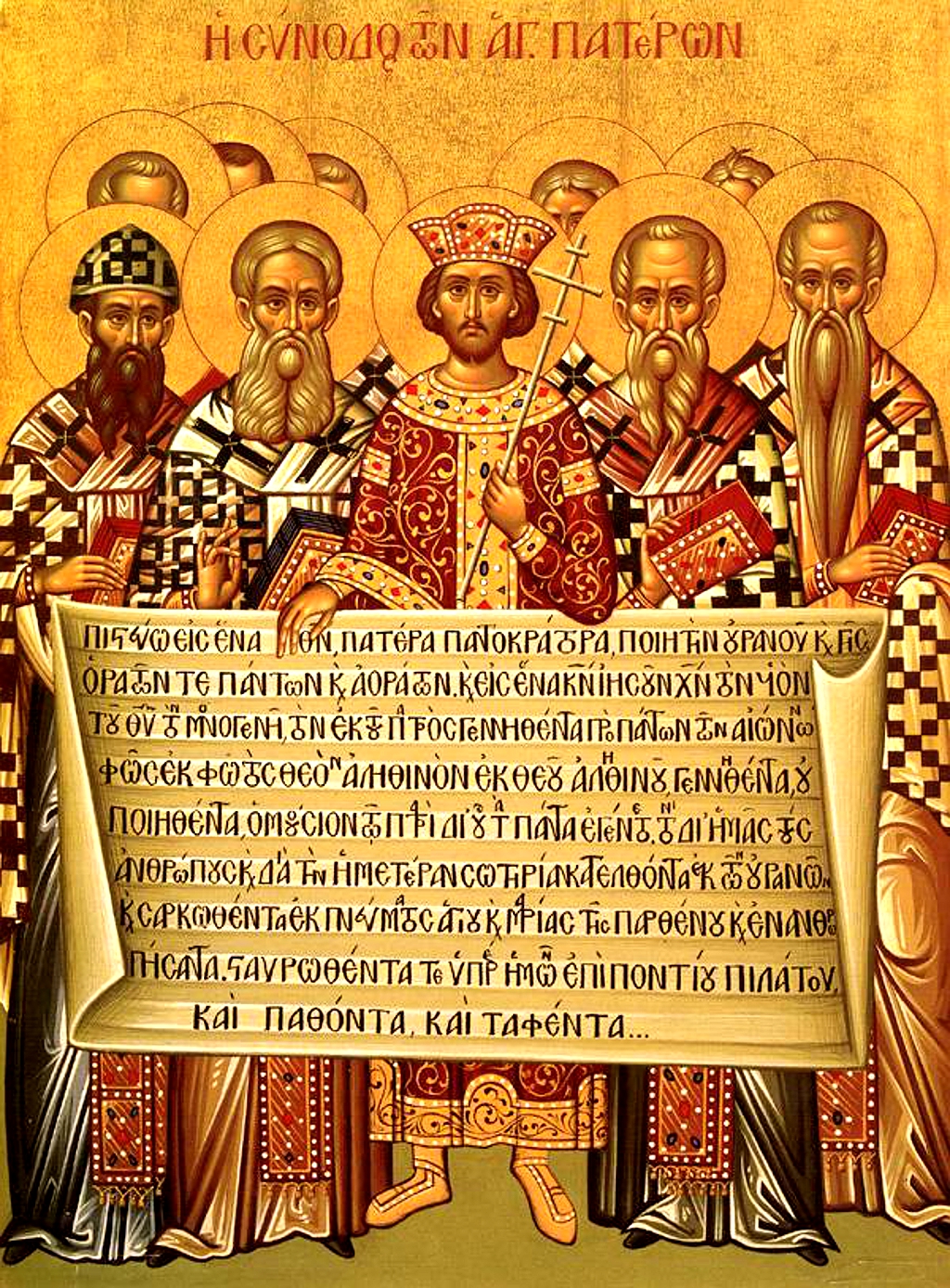
This icon depicts the First Council of Nicaea, the first ecumenical council of the Christian Church, held in 325 CE. It shows the Emperor Constantine and the assembled bishops (the "Fathers" of the council) holding the text of the Nicene Creed. (Tradition)
A note on the image itself
A word of caution belongs at the front. The image is treated on Wikimedia Commons as public domain because it is held to have been published before 1 January 1931, but the date of the icon itself is not documented in the source record. Its age, painter and origin are not established. It should therefore be read as an illustrative devotional image of the council's subject, not as a securely dated historical artefact. (Scholarship) What can be stated with confidence is the event it depicts, not the object's own history.
The event depicted
The Council of Nicaea was convened in 325 CE to address disputes over Christian doctrine, above all the teaching associated with Arius concerning the relationship of the Son to the Father. Its principal outcome was the Nicene Creed, a statement of faith that became foundational across the later Christian traditions. (Tradition) The council is a landmark in the history of the early Church, several generations after the apostolic age.
Relevance to Paul, with due caution
Here too a careful distinction is needed. Nicaea took place nearly three centuries after the Apostle Paul, and Paul had no part in it. The connection is indirect: the theology hammered out at Nicaea drew deeply on the New Testament, including the letters attributed to Paul, and the bishoprics of Asia Minor and Cilicia — the region of Paul's birth — belonged to the wider Church that such councils served. (Scholarship) The icon is included in this archive as a witness to how the faith Paul helped carry into the gentile world was later defined, not as evidence about Paul himself. For the growth of the Church in the centuries between, see early Christianity.
The apostolic memory at the root of that story is what St Paul Global Week marks. On 28-30 June 2027, around the 29 June Solemnity of Saints Peter and Paul, a faith-tourism gathering organised by Funny Tourism will bring pilgrims to Tarsus and Mersin. See the programme.
Provenance
An icon of the First Council of Nicaea, uploaded to Wikimedia Commons from Mediatheque chretienne and marked as public domain on the basis of publication before 1 January 1931. Important caveat: the date of the icon itself is not documented in the source record. The subject is the Council of 325 CE, but the age and origin of this particular icon are not established; it is presented here only as an illustrative public-domain image, not as a dated artefact.
Credit and source
- Source:
- Uploaded from Mediatheque chretienne (via Wikimedia Commons)
- Licence:
- Public Domain (published before 1 January 1931)
- Original:
- View the source
Frequently asked questions
What does the icon depict?
It depicts the First Council of Nicaea of 325 CE, the first ecumenical council of the Christian Church, showing the Emperor Constantine and the assembled bishops holding the Nicene Creed.
How old is the icon?
The date of the icon itself is not documented. Wikimedia Commons treats it as public domain on the basis of publication before 1 January 1931, but its age, painter and origin are not established. Only the event it depicts, the Council of 325 CE, can be stated with confidence.
How does the Council of Nicaea relate to St Paul?
Only indirectly. Nicaea took place nearly three centuries after Paul, who had no part in it. The council's theology drew on the New Testament, including the letters attributed to Paul, and served the wider Church that included the region of his birth. The icon illustrates that later legacy, not Paul himself.
St Paul Global Week · 28–30 June 2027
Experience it in person
Gather in the birthplace of the Apostle Paul. An international gathering in Tarsus and Mersin, held around the Solemnity of Saints Peter and Paul, with the Feast Day prayer programme broadcast live worldwide.
Travel and pilgrimage are arranged by Funny Tourism.