manuscript
Codex Sinaiticus: 1 Timothy 1-2 (4th century)
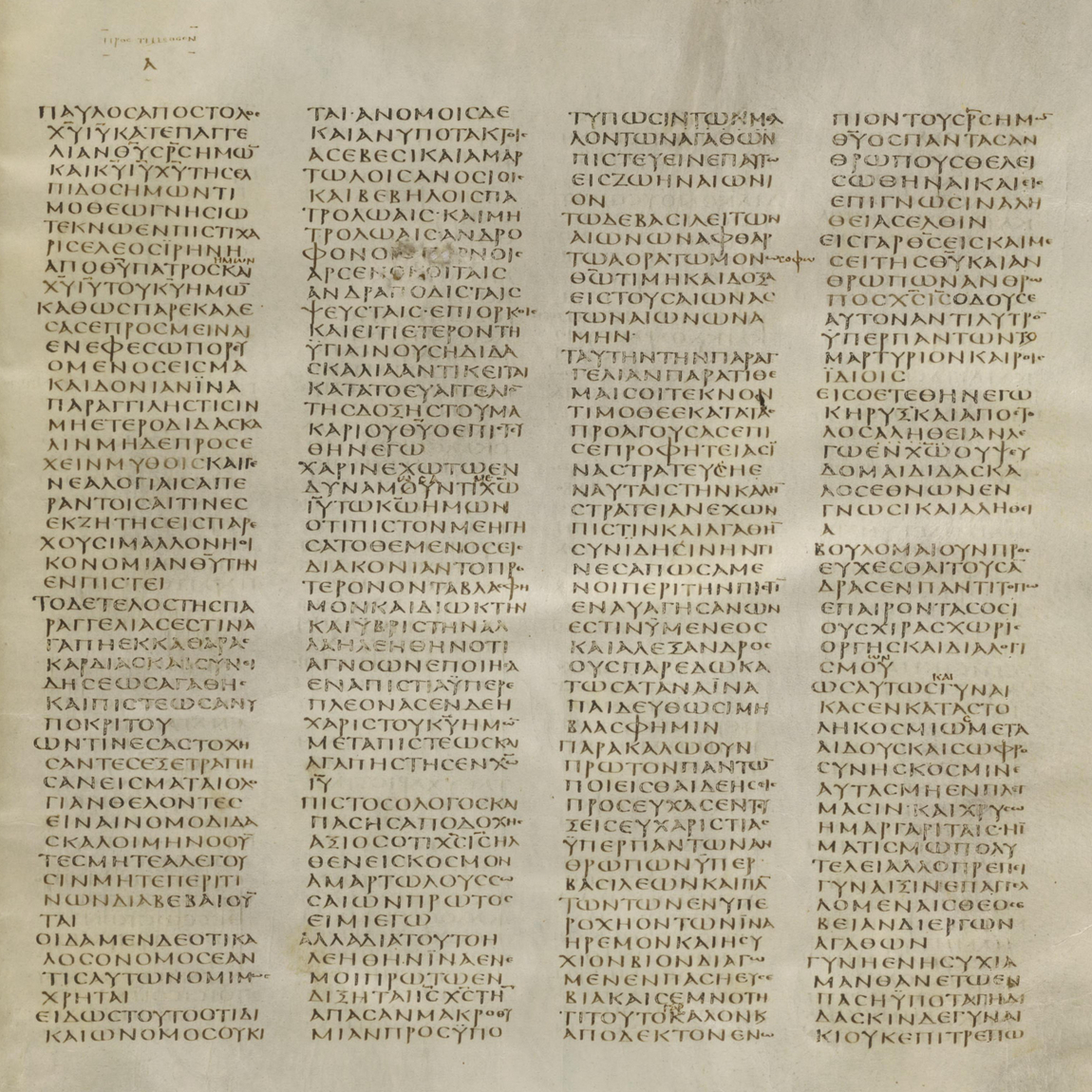
This page from Codex Sinaiticus shows the opening of the First Epistle to Timothy (1 Timothy 1-2). Codex Sinaiticus is a Greek Bible copied in the fourth century CE — roughly the years 330-360 on the usual dating — and it is one of the two oldest substantially complete manuscripts of the Christian scriptures. (Scholarship) The London portion is held by the British Library as Add MS 43725.
What it is
The codex was written by professional scribes on fine parchment, in Greek majuscule (capital) letters arranged in columns. Its pages preserve much of the Old Testament in Greek and a complete New Testament, making it a primary witness to the early text. (Scholarship) The page reproduced here carries the beginning of 1 Timothy, which opens: "Paul, an apostle of Jesus Christ, according to the commandment of God our Saviour, and Christ Jesus our hope" (1 Timothy 1:1, Douay-Rheims). (Scripture)
A Pauline letter, with a note on authorship
1 Timothy is one of the three Pastoral Epistles (1-2 Timothy and Titus). It bears Paul's name in its opening line, and it is transmitted among the Pauline letters. It should be noted, however, that the Pauline authorship of the Pastorals is disputed among scholars: many regard them as written by a follower in Paul's name, while others defend their authenticity. (Scholarship) This is a question about historical authorship, not about the letter's place in the biblical canon, where it is universally received. The manuscript is significant regardless of that debate, as an early physical witness to how the letter was copied and read.
Relevance to Paul
Codex Sinaiticus lets us see the Pauline corpus as it stood in a great fourth-century Bible, only a few centuries after the letters attributed to the Apostle Paul were written. It sits alongside far older fragments such as Papyrus 46 in the chain of witnesses to his text. For the man behind the letters, born in Tarsus, see the reference on the Apostle Paul.
That legacy is what St Paul Global Week marks. On 28-30 June 2027, around the 29 June Solemnity of Saints Peter and Paul, a faith-tourism gathering organised by Funny Tourism will bring pilgrims to Tarsus and Mersin. See the programme.
Provenance
A page of Codex Sinaiticus, a fourth-century Greek Bible; the London portion is held by the British Library as Add MS 43725. The image is released under a CC0 1.0 public domain dedication and hosted on Wikimedia Commons. Codex Sinaiticus is public domain by age; the digitisation was produced by the Codex Sinaiticus Project partners.
Credit and source
- Source:
- British Library, Add MS 43725 (via codexsinaiticus.org / Wikimedia Commons)
- Licence:
- CC0 1.0 (public domain dedication)
- Original:
- View the source
Frequently asked questions
What is Codex Sinaiticus?
It is a Greek Bible copied in the fourth century CE, one of the two oldest substantially complete manuscripts of the Christian scriptures. The London portion is held by the British Library as Add MS 43725. The page shown here contains the opening of the First Epistle to Timothy.
Is 1 Timothy really by Paul?
The letter bears Paul's name and is transmitted among his epistles, but the Pauline authorship of the Pastoral Epistles (1-2 Timothy and Titus) is disputed among scholars; many regard them as written by a follower in his name. This is a question of historical authorship, not of the letter's canonical standing.
Is the image public domain?
Yes. The manuscript is public domain by age, and this reproduction is released under a CC0 1.0 public domain dedication on Wikimedia Commons, from the digitisation associated with the Codex Sinaiticus Project and the British Library.
St Paul Global Week · 28–30 June 2027
Experience it in person
Gather in the birthplace of the Apostle Paul. An international gathering in Tarsus and Mersin, held around the Solemnity of Saints Peter and Paul, with the Feast Day prayer programme broadcast live worldwide.
Travel and pilgrimage are arranged by Funny Tourism.